|
|
| Bitset () |
| | An empty set, with minimal preallocated storage.
|
| |
| | Bitset (int n, bool full=false) |
| | An empty set with preallocated storage for elements 0..n-1. More...
|
| |
|
| Bitset (const GenericSet< Bitset > &s) |
| | Copy of a disguised Bitset object.
|
| |
|
template<typename TSet > |
| | Bitset (const GenericSet< TSet, int > &s) |
| | Copy of an abstract set of integers.
|
| |
|
template<typename TSet , typename E2 , typename Comparator2 , typename = typename std::enable_if<std::is_convertible<E2, int>::value>::type> |
| | Bitset (const GenericSet< TSet, E2, Comparator2 > &s) |
| | Copy of an abstract set with element conversion.
|
| |
|
| Bitset (gmp_randstate_t rnd, unsigned long bits) |
| | Fill with a prescribed number of random bits.
|
| |
|
Bitset & | operator= (const GenericSet< Bitset > &s) |
| | Assign elements from a disguised Bitset object.
|
| |
|
void | reserve (int n) |
| | Reserve storage for n elements.
|
| |
|
void | clear () |
| | Make the set empty.
|
| |
|
template<typename TSet > |
| Bitset & | operator= (const GenericSet< TSet, int > &s) |
| | Assign elements from an abstract set of integers.
|
| |
| int | size () const noexcept |
| |
| Bitset & | operator+= (int i) |
| |
| Bitset & | operator-= (int i) |
| |
|
Bitset & | operator-= (const Bitset &s) |
| | difference
|
| |
|
Bitset & | operator*= (int i) |
| | intersection
|
| |
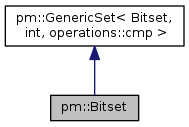
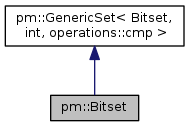
Container class for dense sets of integers.
A special class optimized for representation of a constrained range of non-negative integer numbers. Its implementation is based on the GMP (mpz_t), see http://www.swox.com/gmp/ You should consider to use it instead of the more general Set<int> if all these criteria hold:
- the element range stays constant during the lifetime of the set
- the element range is small (magnitude of tens), or the fill grade (number of elements divided through the element upper bound) is expected to be rather high (>= 0.5)
- the number of random access operations (testing/addition/removal of single elements) prevails significantly over the number of sequential visits via iterators
Note that unlike std::bitset, the element range is not hard encoded in the Bitset object, but can be dynamically changed any time.


 1.8.11