|
|
int | dim () const |
| | tell the current vector dimension, i.e., the number of non-zero elements (may differ from size)
|
| |
|
| SparseVector () |
| | create as empty
|
| |
|
| SparseVector (int dim_arg) |
| | create vector of length n, (implicitly) initialize all elements with 0
|
| |
| template<typename Iterator , bool enabled = construct_sparse_iterator<Iterator, E>::enabled> |
| | SparseVector (int dim_arg, Iterator &&src) |
| |
|
| SparseVector (const GenericVector< SparseVector > &v) |
| | Copy of a disguised SparseVector object.
|
| |
|
template<typename Vector2 > |
| | SparseVector (const GenericVector< Vector2, E > &v) |
| | Create a vector as a copy of another vector of the same element type.
|
| |
|
template<typename Vector2 , typename E2 > |
| | SparseVector (const GenericVector< Vector2, E2 > &v, typename std::enable_if< can_initialize< E2, E >::value, void ** >::type=nullptr) |
| | Create a vector as a copy of another vector with a different element type.
|
| |
| template<typename E2 , typename = typename std::enable_if<can_initialize<E2, E>::value>::type> |
| | SparseVector (std::initializer_list< E2 > l) |
| |
| | SparseVector (int d, std::initializer_list< std::pair< int, E >> l) |
| |
|
void | clear () |
| | truncate to zero size
|
| |
|
void | resize (int n) |
| | change the size, initialize appended elements with default constructor
|
| |
|
reference | operator[] (int i) |
| | random access, may cost O(log(n)) time; Performance Comparison of Vector Classes
|
| |
|
const E & | operator[] (int i) const |
| | constant random access, may cost O(log(n)) time; Performance Comparison of Vector Classes
|
| |
|
template<typename Vector2 , typename E2 , typename = typename std::enable_if<can_initialize<E2, E>::value>::type> |
| SparseVector & | operator|= (const GenericVector< Vector2, E2 > &v) |
| | append a GenericVector
|
| |
|
template<typename E2 , typename = typename std::enable_if<can_initialize<E2, E>::value>::type> |
| SparseVector & | operator|= (E2 &&r) |
| | append an element
|
| |
| template<typename E2 , typename = typename std::enable_if<can_initialize<E2, E>::value>::type> |
| SparseVector & | operator|= (std::initializer_list< E2 > l) |
| |
|
void | remove0s () |
| | remove all zero elements which might have been overseen in some previous operation
|
| |
| top_type & | operator+= (const GenericVector< TVector2 > &v) |
| |
| top_type & | operator-= (const GenericVector< TVector2 > &v) |
| |
|
top_type & | operator*= (const Right &r) |
| | multiply with an element
|
| |
|
top_type & | operator/= (const Right &r) |
| | appending an element
|
| |
|
top_type & | div_exact (const Right &r) |
| | divide by an element
|
| |
|
top_type & | dehomogenize () |
| | divides by the first element
|
| |
|
top_type & | dehomogenize_trop () |
| | subtracts first element
|
| |
|
| std::enable_if< isomorphic_to_container_of< IndexSet, int >::value, IndexedSlice< unwary_t< SparseVector< E > > &, const typename Concrete< IndexSet >::type & > >::type | slice (const IndexSet &indices) |
| |
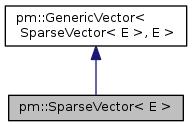
template<typename E>
class pm::SparseVector< E >
Vector type class which is an associative container with element indices (coordinates) as keys; elements equal to the default value (ElementType(), which is 0 for most numerical types) are not stored, but implicitly encoded by the gaps in the key set. It is based on an AVL tree.
template<typename E>
template<typename Iterator , bool enabled = construct_sparse_iterator<Iterator, E>::enabled>
Create a vector of dimension n, initialize the elements from a data sequence. Iterator can be either indexed, or supply index-value pairs, e.g. std::pair<int,ElementType> or a plain sequence of data items. In the latter case zero elements are filtered out.



 1.8.11